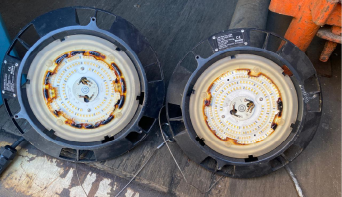
Why Emergency Lighting Is Critical Infrastructure


Why Emergency Lighting Is Critical Infrastructure
In industrial facilities, lighting failure isn’t just an inconvenience — it’s a safety and operational risk. Whether caused by power loss, electrical faults, or emergency shutdowns, even a few seconds of total darkness can create serious hazards for personnel, as well as a risk to machinery, and production processes.
Emergency lighting is therefore a safety-critical system, not a luxury. It ensures continued visibility for safe evacuation, supports critical process continuity where needed, and therefore should meet both statutory compliance and risk management standards.
The Risks of Inadequate Emergency Lighting
Personnel Safety and Evacuation Delays
In heavy industrial or mining environments, loss of visibility during power failure can result in injury or fatality due to slips, trips and falls, exposure to moving machinery, or loss of orientation. Poorly designed escape lighting can lead to non-compliance with emergency egress routes.
Process and Equipment Damage
Many industrial sites operate furnaces, presses, or conveyors that require controlled shutdown. Without sufficient emergency illumination, operators cannot safely access or disengage equipment, increasing the likelihood of damage and production downtime.
Regulatory Non-Compliance
South African regulations such as SANS 10114-2: Emergency Lighting, SANS 1464-22 : 2024 and SANS 10400-T : 2024 mandate minimum illuminance levels for escape routes, open areas, and high-risk task areas. Compliance also aligns with the Occupational Health and Safety Act 2025 (OHS Act), which requires adequate emergency egress and visibility. Non-compliance exposes companies to legal penalties, insurance disputes, operational failures and reputational risk.
Maintenance Oversight and False Security
Systems that are never tested or serviced frequently fail during actual outages. This “false sense of security” is one of the most common causes of underperformance in emergency lighting installations.
Advantages of Well-Designed Emergency Lighting Systems
Improved Safety and Evacuation Efficiency
Properly spaced luminaires ensure visibility of exit routes, fire equipment, and hazard areas even during total power loss. Compliance requires a minimum of 1 lux along escape routes and 20 lux in high-risk task areas
Reduced Downtime and Asset Protection
Emergency lighting allows critical shutdown and control operations to continue, preventing secondary accidents or damage to expensive assets.
Integration with Building and Site Controls
Modern emergency lighting systems can integrate with BMS, SCADA, or smart monitoring platforms, enabling remote diagnostics, fault logging, and automated testing — a major advantage for large industrial facilities.
Enhanced Risk Management and Compliance
Compliance with SANS 10114-2, ISO 30061, and ISO 45001 (Occupational Health & Safety) demonstrates robust safety management and strengthens audit performance.
Types of Emergency Lighting Systems
Emergency lighting in industrial facilities can be categorised by function and power source architecture.
Maintained vs Non-Maintained Luminaires
Maintained Emergency Lighting operates continuously under normal conditions and switches to battery backup during mains failure. It’s ideal for spaces that require constant illumination such as tunnels, control rooms, or high-traffic corridors. Non-Maintained Emergency Lighting remains off during normal operation and activates only when mains power fails, typically used for escape routes, stairwells and general emergency pathways.
Self-Contained (Standalone) Systems
Each luminaire houses its own battery pack, inverter, and test module. Typical Use: mines, warehouses, and industrial corridors.
Central Battery Systems
A single battery bank supplies multiple luminaires through dedicated, monitored circuits. Typical Use: power stations, process plants, and large-scale industrial facilities.
Addressable Emergency Lighting Systems
Advanced DALI-2 or proprietary addressable systems allow for individual luminaire monitoring, automated monthly and annual testing, and complete traceability via SCADA or BMS platforms. These systems dramatically reduce maintenance labour hours and eliminate guesswork in compliance reporting.
Key Design and Specification Considerations
Minimum Illumination:
1 lux for escape routes and 20 lux for high-risk task areas (as per SANS 10114-2 and the OHS Act).
Duration:
Systems must operate for at least 1 hour, or long enough to allow all occupants to exit safely; 90 minutes is typically recommended for industrial or mining applications.
Photometric Modelling:
Use of IES or LDT photometric data for correct luminaire spacing, uniformity, and glare control. All emergency lighting calculations should be done using direct illumination only (i.e. No reflectance to be taken into consideration)
Battery Chemistry:
LiFePO4 batteries are preferred over Ni-Cd due to longer lifespan, thermal stability, and reduced maintenance.
Testing and Monitoring:
Integration of automatic testing or manual test switches as required by the site’s risk profile.
Recommended Ingress and Impact Ratings:
Minimum IP65 and IK08.
Magnitech’s Approach to Industrial Emergency Lighting
Magnitech emergency luminaires are engineered to comply with and even exceed SANS and OHS compliance standards. Each fitting is built with:
High-efficiency LED modules using intelligent current regulation
Sealed IP65/66 housings manufactured from corrosion-resistant materials
Maintained or non-maintained configurations for application versatility
Remote monitoring and testing compatibility to support preventive maintenance
Our philosophy remains simple: safety first, reliability always. Because in an emergency — failure is not an option.
Conclusion
Emergency lighting in industrial environments is not simply a compliance checkbox — it’s a fundamental safeguard for personnel safety, operational continuity, and legal compliance.
Systems must be engineered, not improvised, with every fitting, battery, and circuit designed to perform under real-world conditions.
If you’re planning a new installation, upgrade, or compliance audit, Magnitech’s engineering team can assist with system design, simulation, and validation — ensuring your site is compliant, safe, and ready for anything.